

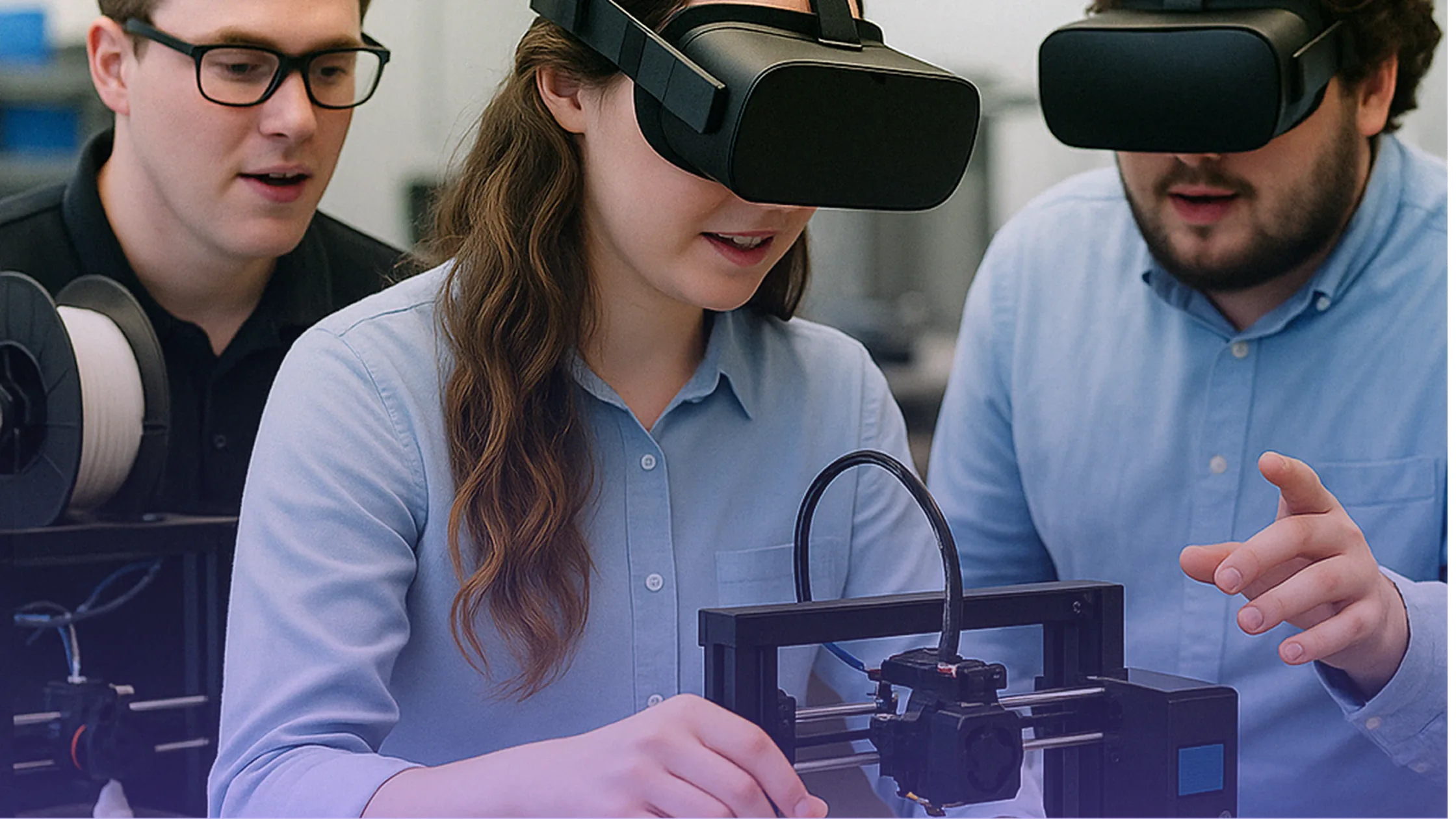
If you’ve ever tried to help someone begin using a 3D printer, you know that the initial learning curve can be steep, especially for students new to engineering. An exciting new study, co-authored by TwinWorks co-founder Mina Ghobrial, explores how a Mixed Reality (MR) tool called HoloPrint aims to flatten that curve, enabling learners to grasp the fundamentals of Filament Deposition Machine (FDM) 3D printing more efficiently and confidently.
The Challenge: Hands-On Learning, Limited Resources
At many engineering schools, practical sessions on 3D printers can be a bottleneck. There’s often only so much equipment, and the teacher can’t be everywhere at once. HoloPrint tackles this challenge by overlaying virtual guides on top of the real-world 3D printer. Students can see exactly what to do and how, step by step, through a MR headset, freeing up instructors to focus on more complex questions instead of basic troubleshooting.
The Study Setup
To assess HoloPrint’s effectiveness, the research team selected a homogenous group of 81 first-year engineering students at INSA Toulouse. In total, 8 classes of about 10 students each participated in the sessions:
- FDM Printer Familiarization: Students donned a headset that displayed a fully interactive “layer” of information on the actual 3D printer.
- Completion of a 3D Print: They followed HoloPrint’s prompts to load filament, prepare the printing bed, and initiate a print job without needing external assistance.
- Feedback and Questionnaires: Each student answered questions about the usability (SUS Scale) and usefulness of HoloPrint.
Key Findings
- 98.8% Success Rate: Nearly every student successfully printed an object without intervention from teaching staff.
- Strong Usability Score: HoloPrint registered an average SUS (System Usability Scale) of 79.69, which sits comfortably in the “Good” range and close to “Excellent.”
- Experience Didn’t Matter: Prior familiarity with 3D printers or VR headsets didn’t significantly affect either the students’ success or their usability ratings. Novices and experienced users alike benefited.
In simpler terms, the tool worked. Students completed a real print job with minimal hiccups, and they found the MR instructions both practical and engaging.
Why Mixed Reality Works So Well
What makes Mixed Reality particularly useful for equipment training?
- Contextualized Guidance: MR overlays instructions on the real machine, so learners don’t have to juggle printed manuals or guess which part corresponds to each step.
- Hands-Free Interaction: By seeing guidelines and prompts in their field of view, students can keep both hands on the equipment, perfect for tasks like loading filament.
- Instant Feedback: HoloPrint can highlight whether an action has been done correctly, or if a step is missing.
Bigger Implications: Beyond Simple FDM Printers
While HoloPrint was tested on a relatively straightforward 3D printer, the success of this proof of concept paves the way for more complex additive manufacturing machines and other types of industrial equipment. If first-year students can confidently learn basic 3D printing tasks using MR, imagine how this technology could be extended to:
- Metal printing systems that have more safety requirements
- Advanced multi-axis machining and engineering systems
- Training scenarios that cover an entire production line rather than a single machine
The study’s authors anticipate rolling out future tests to see how far HoloPrint can push these boundaries.
Bridging the Gap with TwinWorks
The success of HoloPrint highlights the power of interactive, step-by-step guidance
in technical training, a philosophy that also drives TwinWorks.
Just as HoloPrint streamlines 3D printing education through Mixed Reality overlays,
TwinWorks enables industrial teams to author and publish interactive web work
instructions, with beta/limited AR guidance for procedures prepared with AR-ready anchors. Whether guiding a student
through their first 3D print or assisting an operator with complex assembly
procedures, the key is clear, visual, and accessible instructions.
This research suggests questions worth testing for hands-free, immersive guidance.
Device and browser coverage, training outcomes, errors, and learning time should be
measured in the intended environment rather than assumed from another study.
Final Thoughts
Mixed Reality can transform technical education, particularly when it comes to hands-on machinery that once demanded continual supervision. For educators and industry trainers, HoloPrint shows that you don’t need to be an expert with advanced headsets or 3D printing to benefit. Even complete beginners can step up, strap on the headset, and get productive fast.
As MR hardware becomes more accessible, it’s exciting to envision a world where labs, factories, and classrooms all blend real equipment with dynamic digital overlays. Solutions like HoloPrint and TwinWorks are vivid examples of how we can bridge traditional learning gaps, making training more intuitive, visual, and enjoyable for everyone.
Curious about integrating Mixed Reality into your own technical training? Contact us to learn more about how innovations like TwinWorks could elevate your programs.