

Understanding the Limitations of Traditional Manuals
Traditional manuals, often in printed or static PDF formats, present several challenges:
- Lack of Engagement: Static text and images can be monotonous, leading to disengagement and reduced retention among users.
- Difficulty in Updates: Updating printed manuals is cumbersome, often resulting in outdated information being in circulation.
- Limited Access: Physical manuals can wear out and are often difficult to access in certain work environments.
The Advantages of Interactive Instructions
Transitioning to interactive instructions offers numerous benefits:
- Enhanced Engagement: Interactive content, such as clickable links, embedded videos, and animations, makes information more engaging and easier to understand.
- Ease of Updates: Digital platforms can reduce the editing and redistribution work associated with procedure changes, while review and release still require control.
- Improved Access: Web delivery can make approved manuals easier to reach on supported devices. Validate browser, network, offline and point-of-use requirements before rollout.
Use Cases for Interactive Instructions in Process Optimization
Implementing interactive instructions can significantly streamline technical processes:
- Assembly Procedures: Interactive 3D models can guide users through complex assembly tasks, reducing errors and improving efficiency.
- Maintenance Tasks: Augmented Reality (AR) can overlay instructions directly onto equipment, providing real-time guidance and reducing downtime.
- Training Simulations: Virtual training simulations offer hands-on practice in a controlled environment, enhancing skill acquisition and retention.
Comparing Costs and ROI: Traditional vs. Interactive Documentation
Investing in software solutions for digital instructions can yield substantial returns through improved performance and reduced operational costs:
- Training workflow: Interactive material can make demonstrations and practice easier to structure. Measure time to competence with representative users rather than assuming a fixed result.
- Task consistency: Clear visual steps can reduce ambiguity. Validate the effect on mistakes and rework in the actual process.
- Distribution: Digital instructions can reduce repeated distribution work across sites, while release, translation, and local-access controls still require validation.
Build interactive instructions from reviewed source material
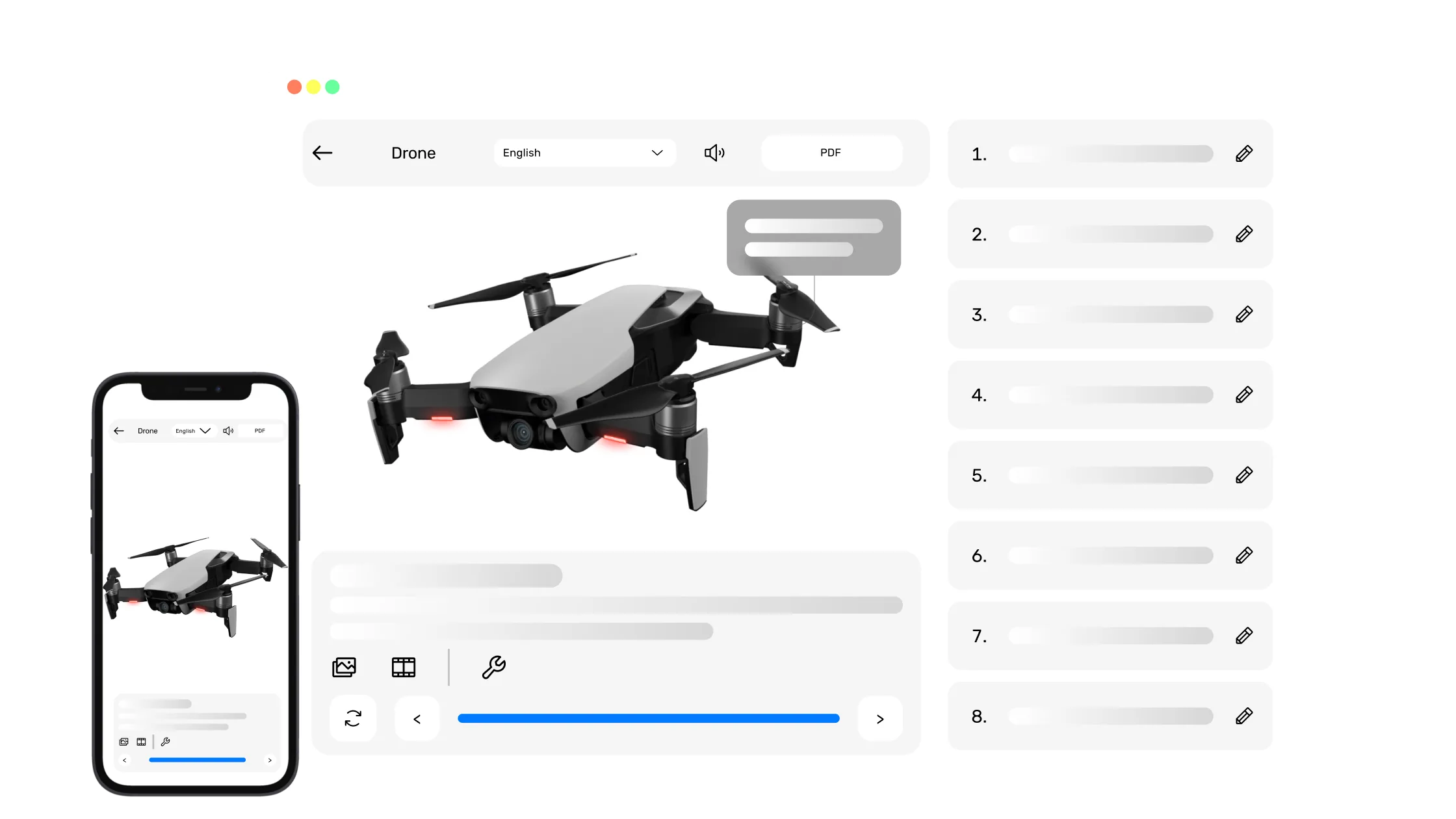
TwinWorks can prepare a review-ready procedure draft grounded in uploaded PDFs. Authors edit the steps, add visual product context from supported 3D formats, and keep expert review in control before publishing. The current verified workflow does not automatically generate procedure steps from CAD.
Conclusion
Moving from traditional manuals to interactive instructions is a workflow decision, not a guaranteed outcome. Test a representative procedure and measure comprehension, errors, revision effort, and operational fit before scaling.
Evaluate the workflow on one real procedure: explore TwinWorks digital work instructions for manufacturing or request a documentation working session.