Glossary
What is a standard operating procedure (SOP)?
A written, approved document that sets out how a routine process is carried out: who does what, and when.
Names vary: depending on the company and the sector, people say procedure, operating procedure or simply SOP.
Where the SOP sits
- Policies and processesWhy and what: the quality policy and the process map
- Standard operating proceduresWho does what, and when
- Work instructionsHow to do one task, step by step
- Forms, checklists and recordsThe evidence that the work was done
Ten parts. One procedure.
What an SOP contains, from the header to the revision history.
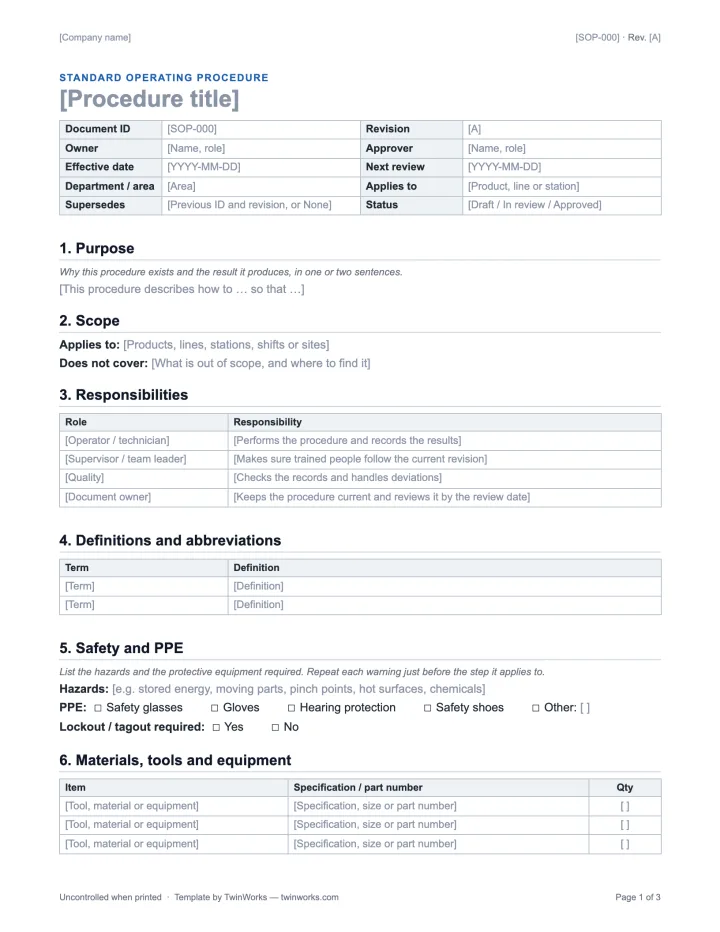
- Header Title, document number, revision, effective date, owner and approver.
- Purpose Why the procedure exists.
- Scope The process, products, sites and people it applies to.
- Responsibilities Who does each part, and who approves.
- Definitions and references Terms, standards and related documents, including the work instructions it calls.
- Safety Hazards, protective equipment and precautions.
- Materials and equipment What is needed before starting.
- Procedure The steps in order, with the decision points.
- Records The forms and checklists to fill in, and where they are kept.
- Revision history What changed, when and why.
Three documents. Three questions.
An SOP calls work instructions for its hands-on tasks, and the record it asks for is often a checklist.
-
Standard operating procedure
Who does what, and when, across a whole process.
-
Work instruction
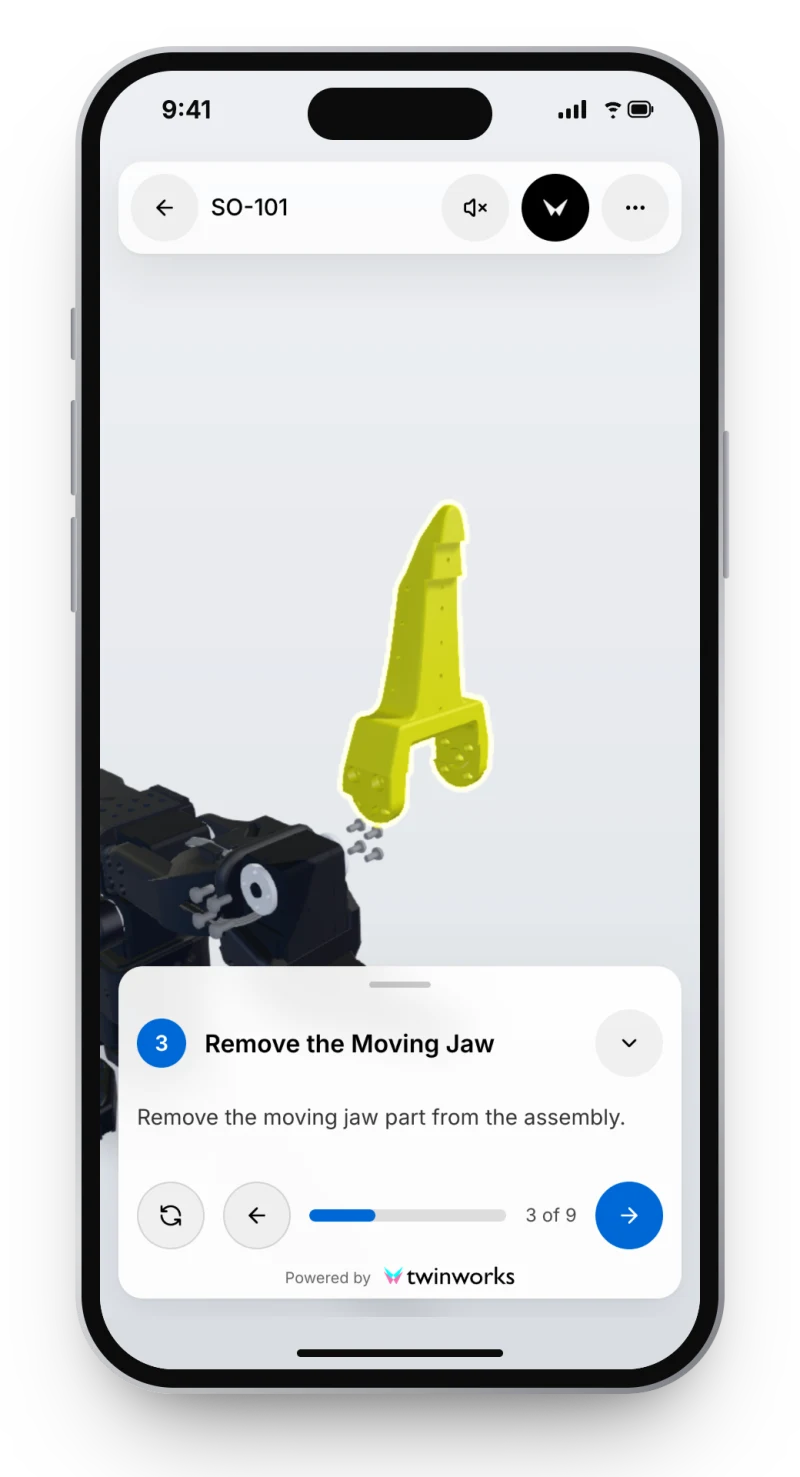
How to do one task, every action and check, with a visual for each step.
-
Checklist
The items to do or verify, ticked by someone who knows the task.
| Criterion | Standard operating procedure | Work instruction | Checklist |
|---|---|---|---|
| Question it answers | Who does what, and when? | How exactly is this task done? | Has every item been done or checked? |
| Scope | A whole process, often across several roles | One task, at one workstation | The items of one task or one inspection |
| Level of detail | Steps at the level of the process | Every action, tool, setting and check, with visuals | Short items, without explanation |
| Reader | Everyone involved in the process, and auditors | The operator or technician doing the task | Someone who already knows the task |
| Example | Receiving inspection of purchased parts | Measure a bearing seat with a micrometer | Forklift check before each shift |
For the next level of detail, read what work instructions are, and for repetitive work paced by demand, standard work.
A short SOP. On one page.
The SOP says who does what; step 4 hands the hands-on detail to a work instruction, and step 5 produces the record.
SOP-QA-012 · Rev. CEffective 2026-11-04
Receiving inspection of purchased parts
- Purpose
- Make sure that only conforming parts go into stock.
- Scope
- All purchased mechanical parts delivered to the main warehouse.
- Responsibilities
- Goods-in operator: steps 1 to 3 and 6. Quality inspector: steps 4 and 5. Quality manager: owns this SOP.
Procedure
- Check the delivery note against the purchase order.
- Inspect the packaging, and photograph any damage.
- Move the parts to the inspection area and tag them “Awaiting inspection”.
- Inspect a sample to the sampling plan, with the work instruction for the part family, such as WI-QA-031 for shafts.
- Record the results on form F-QA-012, then release or quarantine the batch.
- Book the released parts into stock in the ERP system.
Records
Form F-QA-012, kept for five years.
Write one in seven steps.
- Name the process and its owner, and agree on the scope.
- Interview the people who do the work, and watch it being done.
- Write the steps in order, one action per step, in the imperative.
- Name who does each step, and mark where a decision or a record is needed.
- Move the hands-on detail into work instructions, and link them.
- Test the draft with someone new to the process, and fix what they misread.
- Approve it, publish one current version where people work, and set a review date.
Read the full guide on how to create SOPs, or start from the free SOP template.
Digital SOPs and work instructions
One approved version, where people work.
Paper SOPs drift out of date as copies multiply. Published TwinWorks documentation opens in a browser from a link or a product QR code, from one approved version, and manuals can also be published as PDF.
Reviewers comment, request changes and approve each new revision.
Questions
What is a standard operating procedure (SOP)?
A standard operating procedure (SOP) is a written, approved document that sets out how a routine process is carried out in an organization: what it is for, who is responsible, the steps in order and the records to keep. SOPs make a process repeatable, whoever performs it. They are part of most quality management systems, and in regulated industries such as pharmaceuticals, written procedures are mandatory.
What is the difference between an SOP and a work instruction?
An SOP describes a whole process: who does what, and when. A work instruction describes one task in full detail, with every action, tool, setting and check, usually with pictures. An SOP often calls several work instructions.
What is the difference between an SOP and a checklist?
An SOP explains how a process is carried out and who is responsible for it. A checklist only lists the items to do or verify, for someone who already knows how. A checklist is often the record an SOP asks for.
What are the main parts of an SOP?
A header with the title, number, revision and approval, then the purpose, scope, responsibilities, definitions and references, safety precautions, materials and equipment, the procedure steps, the records to keep and the revision history.
Does ISO 9001 require SOPs?
Not by that name. ISO 9001:2015 requires the documented information your organization needs to run its processes. Many companies meet that requirement with SOPs and work instructions, but the format is their choice.
Write your SOP from a template
Start from the free SOP template, with the sections a procedure needs, ready to fill in.
Updated