In-house
Technical writers work in a word processor, a DITA tool or an S1000D system.
Glossary
The documents that explain how a product works, and how to install, use, maintain, repair and build it.
Some documents stay with the manufacturer. The others travel with the product.
Technical documentation across a product’s life
The file a manufacturer keeps to prove that a product conforms. That file is for the authorities, not for users.
In EU product law, the term also has a narrower meaning: the file a manufacturer keeps to prove that a product conforms, with its design data, risk assessment and test reports. For machinery, Annex IV of the Machinery Regulation sets its content.
| Document | Reader | What it covers |
|---|---|---|
| User or operator manual (instructions for use) | Operators and end users | Intended use, controls, safe operation, cleaning and simple faults |
| Installation manual | Installers and integrators | Transport, lifting, mounting, connection and commissioning |
| Maintenance and repair manual | Maintenance technicians | Inspections and intervals, removal and installation, adjustments and tests |
| Work instructions | Operators and assemblers | How to do one task, step by step, at the workstation |
| Illustrated parts catalog | Technicians and spare parts buyers | Exploded views and parts lists to identify and order parts |
| Training material | Trainees and trainers | Courses, exercises and animations built on the documentation |
| Technical file | The manufacturer and the authorities | Design data, risk assessment and test reports that prove conformity |
A task header, a warning, a figure, the tools and parts, then the steps.
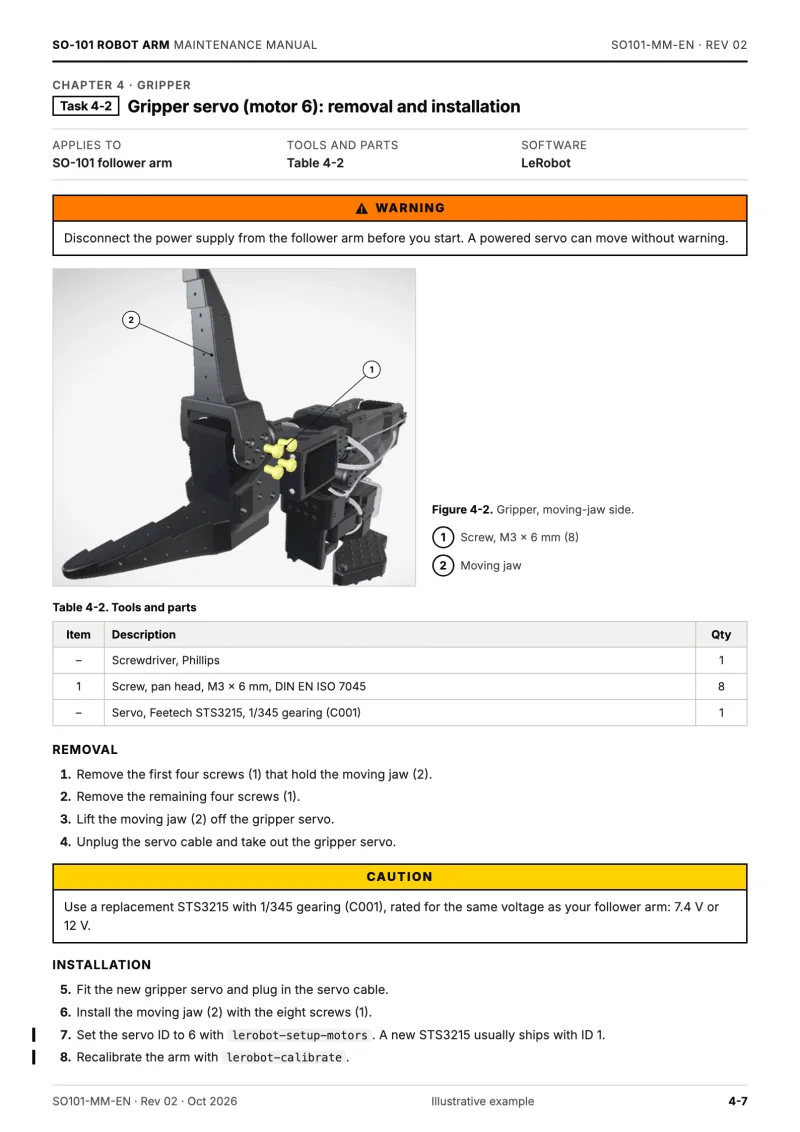
Technical writers work in a word processor, a DITA tool or an S1000D system.
TwinWorks writes installation, operation and maintenance manuals, procedures and illustrated spare parts catalogs from your engineering sources and interviews with your experts, who approve the result.
See the technical writing servicesTwinWorks is AI-assisted technical-publication software that prepares review-ready drafts from linked manuals and parsed engineering data; experts edit, review, approve, version and publish web and PDF documentation.
See technical publication softwareTechnical documentation is the set of documents that explain how a product works and how to install, use, maintain, repair and build it: user and operator manuals, installation manuals, maintenance manuals, work instructions, parts catalogs and training material. Technical writers produce it from engineering data and expert knowledge, and for many products the law requires it, for example the EU Machinery Regulation.
The main types are user and operator manuals, installation manuals, maintenance and repair manuals, work instructions, illustrated parts catalogs, troubleshooting guides and training material, plus the internal technical file that proves a product’s conformity.
User documentation is the part of technical documentation written for end users, such as the user manual and the quick start guide. Technical documentation also covers documents for installers, maintenance technicians, production teams and authorities.
IEC/IEEE 82079-1 is the general international standard for the instructions for use of products. Sector rules add to it, such as S1000D and ATA iSpec 2200 in aerospace, and laws such as the EU Machinery Regulation set what the instructions must contain.
Technical writers, working with the engineers and field experts who supply and check the facts. Many manufacturers also outsource part of the work to technical writing services.
Free templates for user manuals, SOPs, work instructions, assembly instructions and bills of materials, ready to fill in.
Updated