Glossary
What is stress analysis?
Working out how much stress a load puts into a part, where it peaks, and whether the part will hold.
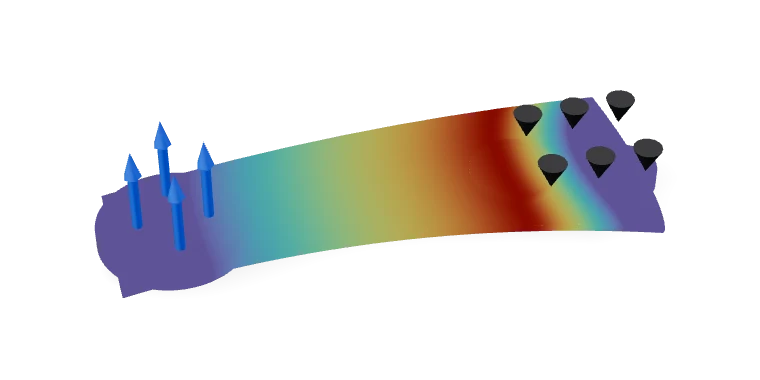
Five numbers. One question: will it hold?
Stress analysis turns a load into numbers you can compare with the material.
-
Stress
Force per area inside the material, in MPa (N/mm²).
-
Strain
How much the material stretches, as a ratio. Stress over strain is its stiffness, E.
-
Von Mises stress
All the stresses at a point rolled into one value, to compare with the yield strength.
-
Safety factor
Yield strength over the highest stress. Above 1 it holds; most designs aim well above.
-
Deflection
How far the part moves. It can be strong enough and still bend too much.
A drone arm, by hand. Six lines of math.
One arm of a racing drone, treated as a beam held at the frame and lifted by its motor.
| Step | Formula | Result |
|---|---|---|
| Bending moment at the root | M = F × L = 15 × 65 | 975 N·mm |
| Section modulus | Z = b h² / 6 = 34 × 6² / 6 | 204 mm³ |
| Stress at the root | σ = M / Z = 975 / 204 | 4.8 MPa |
| Safety factor | SF = S / σ = 45 / 4.8 | 9.4 |
| Second moment of area | I = b h³ / 12 = 34 × 6³ / 12 | 612 mm⁴ |
| Tip deflection | δ = F L³ / (3 E I) = 15 × 65³ / (3 × 1,700 × 612) | 1.3 mm |
By hand or by FEA. Use both.
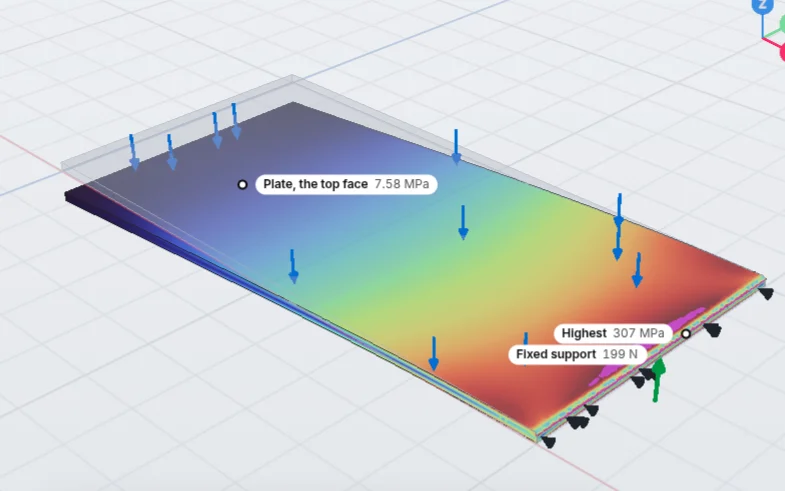
A formula is quick and easy to check. FEA handles the real shape, and each one checks the other.
| Method | Gives | Watch out for |
|---|---|---|
| Hand calculation | One number at one place, in minutes | A formula that does not match the shape or the supports |
| FEA, finite element analysis | The stress everywhere, and where it peaks | Wrong supports, loads or mesh; red spots at sharp corners |
| Physical test | What the real part does, material and joints included | Cost and time; one load case per test |
TwinWorks runs FEA on the model you design: see its FEA software.
Common mistakes. Six checks.
Most wrong answers come from the set-up, not the solver.
- The supports match how the part is really held. A support stiffer than reality hides stress.
- Red spots at sharp inside corners are read with care. There, the stress keeps rising as the mesh gets finer.
- The load case is the one that matters. A drone arm is sized by crashes, not by hover thrust.
- The units agree. Newtons and millimeters give MPa; newtons and meters give pascals.
- The stress stays below yield. Past it, a linear study no longer tells what the part would see.
- One number is checked by hand before the colors are trusted.
Questions
What is stress analysis?
Stress analysis works out how much stress a load puts into a part, where it peaks and whether the part will hold. It uses hand calculations, finite element analysis (FEA) or physical tests, and compares the result with the strength of the material.
What is von Mises stress?
A single equivalent stress worked out from all the stresses at a point. Ductile metals start to yield when it reaches their yield strength, which is why most FEA results show it. For brittle materials such as cast iron or glass, the largest principal stress is often the better check.
What is a good safety factor?
It depends on how well the loads and the material are known, and on what a failure would cost. Values from 1.5 to 4 are common in machine design. Where a code or standard applies, such as for pressure equipment or lifting gear, it sets the minimum.
What is the difference between stress and strain?
Stress is the force per area inside the material, in MPa. Strain is how much the material stretches as a result, a ratio with no unit. In the elastic range, stress divided by strain is the material's Young's modulus.
Is stress analysis the same as FEA?
No. FEA is one way to do stress analysis. Hand calculations and physical tests are others, and the most reliable answers use more than one.
Which software is used for stress analysis?
FEA software: commercial suites such as Ansys Mechanical and Abaqus, free open-source solvers such as CalculiX and Code_Aster, and simulation built into CAD tools. TwinWorks runs stress, frequency and heat studies on the model you design, in the browser.
Run a stress study on your model.
Hold it, load it, and read the safety factor.
Updated