Glossary
What are EVT, DVT and PVT?
EVT, DVT and PVT are the three test builds a hardware product goes through between the first prototype and mass production.
Five product development stages. Three of them are tests.
Each build answers one question before the money for the next one is spent.
PrototypeProof of concept
- Can it work?
- 3D prints, development boards, hand wiring
- A few units
EVTEngineering validation
- Does the design work?
- Prototype parts, production-intent boards
- Often tens of units
DVTDesign validation
- Does it meet every requirement?
- First parts from production tools
- Often tens to hundreds
PVTProduction validation
- Can the factory build it?
- The real line, fixtures and trained operators
- Hundreds or more
MPMass production
- Ramp to full rate
- Changes go through change orders
- Volume
What each build proves. And when to move on.
| Build | Proves | Built with | Move on when |
|---|---|---|---|
| EVT, engineering validation test | The design works: every function, the electronics, the first firmware, power and heat. | Prototype processes such as machining, 3D printing and soft tooling, with production-intent circuit boards. | Every function meets the specification and the design fixes are known. |
| DVT, design validation test | The design meets every requirement when made the production way: drop, temperature, life, looks and certification. | First parts from production tools, in production materials and finishes. | The design is frozen and the certification tests pass. |
| PVT, production validation test | The factory can build it at rate and at quality. | The production line, its tools, fixtures, test stations and work instructions, with trained operators. | Yield, cycle time and quality reach their targets. |
The later the change, the more it costs.
A fix that costs a reprint in EVT can cost a new mold after DVT, and a stopped line in PVT.
What a design change means
- PrototypeEdit the CAD and print again.Hours to days.
- EVTA new board revision or a new machined part.Days to weeks.
- DVTProduction tools are cut: a change can mean reworking a mold.Weeks, and a tooling bill.
- PVTThe line is set up: a change can stop it.Every fixture, test and document it touches.
- MPAn engineering change order.New revisions, stock to use up, documents to update.
Each build leaves documents. PVT needs them final.
By PVT, operators build from released drawings, the manufacturing BOM and work instructions, not from an engineer standing beside them.
- Bill of materials The engineering BOM in EVT, the manufacturing BOM by PVT.
- Drawings and specifications Released, with tolerances, before production tools are ordered.
- Test reports Each build’s results, and the changes they caused.
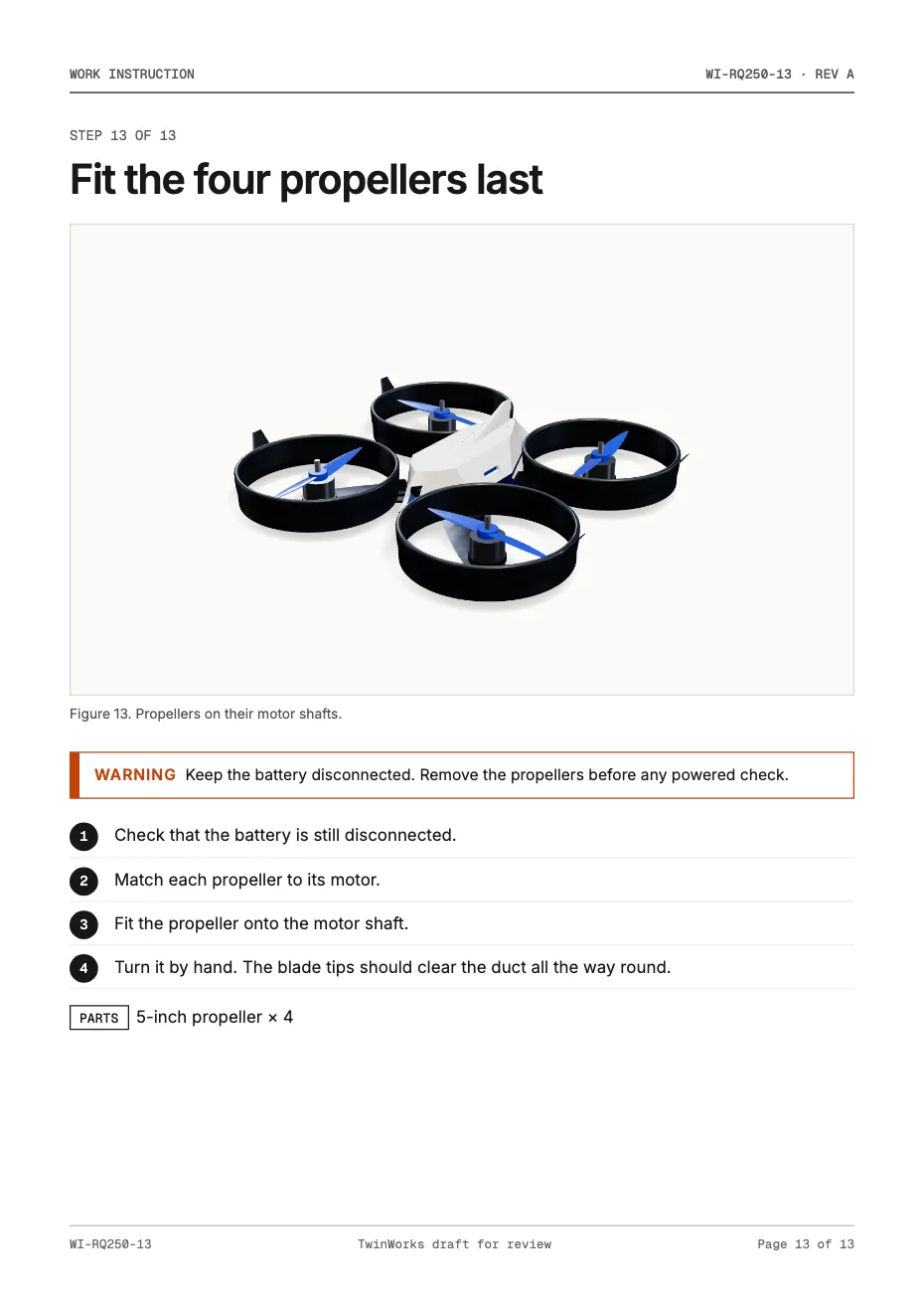
- Work instructions The line’s steps, tools and checks, tried in PVT.
Read more about the bill of materials, work instructions and engineering change orders.
Questions
What do EVT, DVT and PVT stand for?
Engineering validation test, design validation test and production validation test. They are the three builds, in that order, that take a hardware product from working prototypes to mass production.
What comes before EVT?
Proof-of-concept and prototype builds, often split into works-like and looks-like prototypes. Some teams add an EVT0 build, or call their early builds alpha and beta.
How many units are built in EVT, DVT and PVT?
It depends on the product and the tests it needs. As a rough guide: tens of units in EVT, tens to hundreds in DVT, and hundreds or more in PVT, built on the real production line.
What is the difference between DVT and PVT?
DVT proves the design: parts from production tools pass reliability, environmental and certification tests. PVT proves the process: the factory builds the frozen design at rate, with the target yield and quality.
Can you skip a stage?
Small-volume or low-risk products often merge stages, for example EVT and DVT. Skipping one does not remove its problems; it moves them to a later and more expensive build.
What is MP?
Mass production: the ramp to full-rate production after PVT. From then on, design changes go through engineering change orders.
Write the line’s work instructions.
Start from the free work instruction template, with a picture, key points and checks for every step.
Updated